My grandpa, Frank, has been a finish carpenter for nearly fifty years.
He’s the kind of man who will drive back across town because he notices a cabinet door is hanging just an eighth of an inch too low.
These days, he hardly advertises at all.
Most of his work comes from old clients recommending him to friends, neighbors, and family.
A few months ago, a wealthy couple hired him for a major renovation project in their newly remodeled home.
They wanted custom cabinets, built-in shelving, and a massive window bench for the downstairs living area.
It was the kind of project that could keep a carpenter busy for weeks.
And these two homeowners were, according to Grandpa, some of the most exhausting clients he had ever dealt with.
First, they changed the cabinet handles.
Twice.
Then they decided a shelf Grandpa had already finished needed to be three inches higher.
So he rebuilt it.
After that, they suddenly hated the stain they had originally approved—even though Grandpa had already purchased all the materials.
He would come home and complain about them over dinner.
But every single time, he ended with the same sentence.
“They’re paying for custom work. I’ll give them custom work.”
So he did.
Every change they requested was approved.
Every measurement was checked twice.
Every additional cost was documented.
And by the final week, the downstairs room looked incredible.
The cabinets were flawless.
The shelves were perfectly aligned.
The enormous window bench fit exactly where it was supposed to.
It was the kind of craftsmanship Grandpa had spent nearly five decades perfecting.
Then, one afternoon, my phone rang.
It was Grandpa.
“You’re not going to believe what these people just tried.”
The homeowners had walked through the completed room that day.
They praised the work.
They took photos.
They even talked about how impressed their friends were going to be when they saw the renovation.
Then the husband pulled Grandpa aside.
He told him they had “gone over their renovation budget.”
And because of that, they weren’t going to pay the remaining $6,200.
At first, Grandpa thought he was joking.
He wasn’t.
Grandpa reminded him that the price had been agreed upon in writing.
The man simply shrugged.
“You’re one old carpenter working by yourself. What are you really going to do about it?”
His wife stood nearby, casually drinking coffee as if nothing unusual was happening.
Then she added, “Everything’s already installed. It’s not like you can take it back.”
That was the moment Grandpa’s expression changed.
My grandpa is one of the least confrontational people I know.
He once apologized to a waitress because she brought him the wrong breakfast.
But this time, he didn’t argue.
He didn’t raise his voice.
He simply stood there for several seconds.
First, he looked at the cabinets.
Then the shelves.
Then the massive window bench.
And finally…
He smiled.
“Okay,” he said.
The husband actually laughed.
Grandpa quietly gathered his tools.
He swept the work area until there wasn’t a single scrap of debris left behind.
Then he told the couple there was just one final piece of paperwork they needed to sign.
It confirmed that they were refusing to pay the remaining balance.
They signed it without even bothering to read the entire document.
Apparently, the wife smiled afterward and said,
“See? That was much easier than making this ugly.”
Grandpa came home that evening looking strangely cheerful.
I asked him why he wasn’t angry.
He opened the refrigerator, grabbed a beer, and leaned against the counter.
“Because tomorrow morning,” he said, “they’re going to understand why I needed their signatures.”
I had no idea what he meant.
Until the next morning.
At exactly 7:46 a.m., my phone started ringing.
It was Grandpa.
He was already standing in the couple’s driveway.
And the second he told me who was standing beside him, I grabbed my keys.
When I arrived ten minutes later, the morning mist was still hanging over the street.
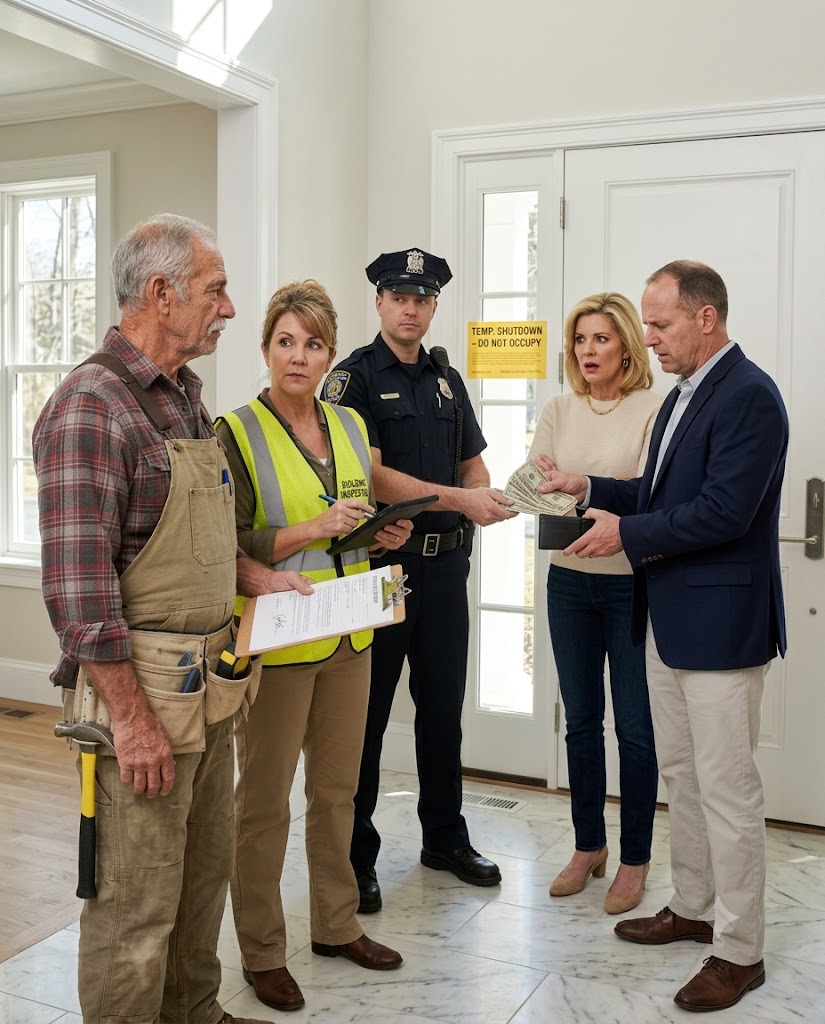
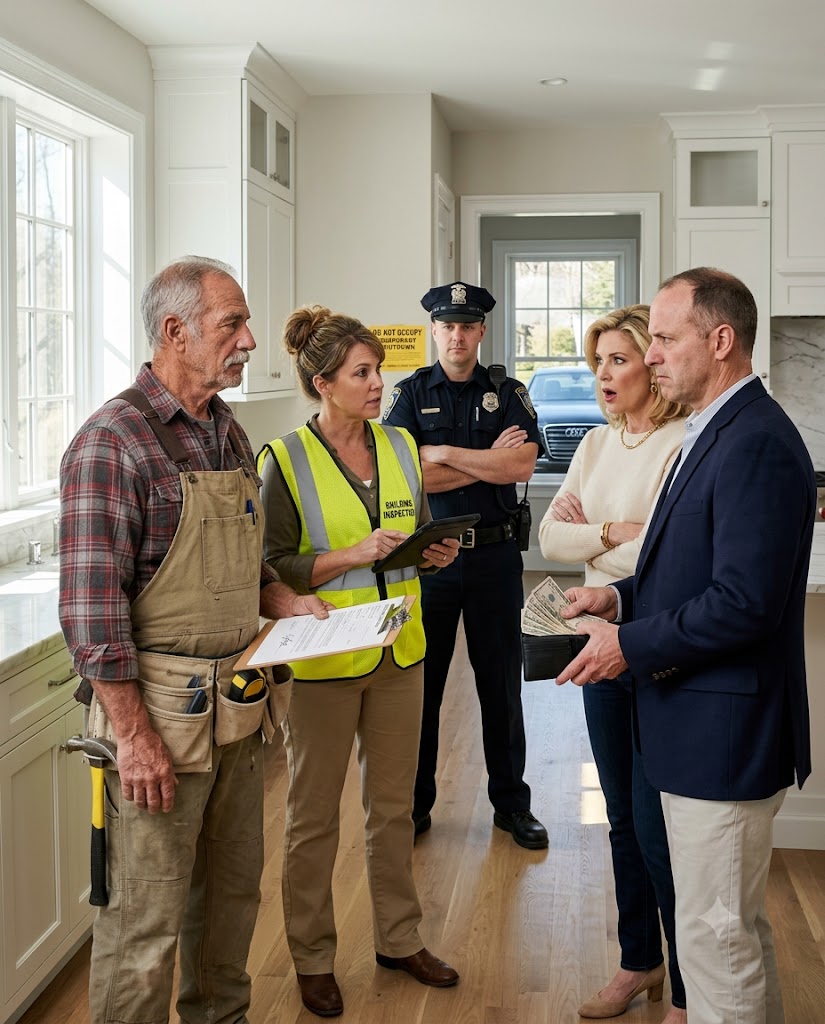
Standing beside Grandpa was Arthur Vance, the county’s chief building inspector.
Arthur had known Grandpa since they were teenagers.
Two uniformed deputies from the sheriff’s department stood nearby.
I barely had time to park before the front door swung open.
The husband stepped onto the stone porch wearing a bathrobe, a coffee mug in one hand and a deeply irritated expression on his face.
“What is the meaning of this?” he demanded.
His eyes locked onto the patrol car parked behind his luxury sedan.
“Frank, I told you yesterday. We’re done doing business. If you’re here to harass us, I’ll have you arrested for trespassing.”
Arthur stepped forward.
He held a thick clipboard in one hand and displayed his official county badge.
“Mr. Harrison, I’m the head municipal building inspector.”
The husband’s expression tightened.
“We aren’t here about a civil payment dispute.”
Arthur paused.
“We’re here to execute an immediate stop-work order and revoke the certificate of occupancy for your entire main floor.”
The man froze.
His coffee mug slowly lowered.
“Revoke what?”
“That’s insane. The permits were cleared last month!”
Grandpa stepped forward.
His hands rested casually inside the pockets of his canvas jacket.
“The paper you signed yesterday afternoon, Mr. Harrison.”
The husband stared at him.
“You didn’t just sign an acknowledgment of non-payment,” Grandpa continued.
“You signed an addendum stating that the custom cabinetry, load-bearing window bench, and wall framing were incomplete, uncertified, and abandoned by mutual refusal of contract.”
The wife had heard the commotion.
She stepped outside wearing a silk dressing gown.
The smug confidence from the previous afternoon was gone.
“Wait,” she said nervously. “What does that have to do with the house?”
Arthur adjusted his glasses.
Then he read directly from the clipboard.
“Under municipal building code section 402, custom built-in architectural millwork integrated into exterior walls requires a final structural and fire-safety clearance before the dwelling can be occupied.”
The couple stared at him.
“Because your signed document legally certifies that the structural bench and surrounding cabinetry were left unfinished,” Arthur continued, “the entire ground-floor living space is classified as an active, uninspected construction hazard.”
He closed the clipboard.
“Effective immediately, red tags are going on your front door.”
The husband’s face went from pale to bright red.
“You can’t do that!”
His voice cracked.
“We’re hosting a dinner party tonight. Fifty people!”
“Not in this room, you aren’t,” one of the deputies said firmly.
“Unless you have a final signed release from the certified master tradesman who pulled the master carpentry permit.”
Slowly, the couple turned toward Grandpa.
The arrogance was gone.
The condescending smiles were gone.
Even their earlier sneering comment about him being “just one old carpenter” seemed to have disappeared from the room.
“Frank…”
The husband hurried down the porch steps.
His voice had changed completely.
“Come on. There has to be some kind of misunderstanding.”
He swallowed.
“Let’s just talk about this like reasonable adults.”
Grandpa reached into his jacket pocket.
He pulled out a fresh receipt book and a ballpoint pen.
He looked at the man calmly.
“I’m always reasonable.”
Then he wrote something down.
“The remaining balance was six thousand two hundred dollars.”
The husband nodded quickly.
“Yes. Exactly. So let’s settle this.”
Grandpa looked up.
“But since the contract was closed out yesterday, this is now an emergency weekend re-inspection and re-certification call.”
The man’s face fell.
“My emergency call-out fee is twenty-eight hundred dollars.”
Grandpa tore the receipt from the book.
“Total comes to $9,000.”
He held out his hand.
“Cash or cashier’s check. Paid right now.”
He nodded toward Arthur.
“Otherwise, Arthur red-tags your front door, and you can reschedule an inspection with the county clerk in four to six weeks.”
The wife looked like she might faint.
The husband glanced at the deputy.
The deputy was already reaching for a roll of red hazard tape.
There was a long silence.
Then the husband turned around.
He practically sprinted back inside.

Three minutes later, he returned carrying a certified bank draft.
He was breathing hard as he signed it over the hood of Grandpa’s pickup truck.
Grandpa carefully checked the amount.
Then he signed the final inspection release with one firm stroke and handed the paperwork to Arthur.
Finally, he turned back toward the couple.
He tipped his cap.
That same gentle, knowing smile returned to his face.
“Pleasure doing business with you.”
Then he added,
“Remember to check those cabinet handles.”
He paused.
“They’re leveled to the sixteenth of an inch.”